汗孔角化症:從可愛的切片到病人阿格里的日常
在顯微鏡下,汗孔角化症(Porokeratosis)的切片常常令人著迷。那一條細長的 cornoid lamella(角質柱),像是一道微縮雕塑,靜靜矗立在角質層裡,帶著某種幾乎詩意的秩序感。這樣的影像乍看之下「很可愛」
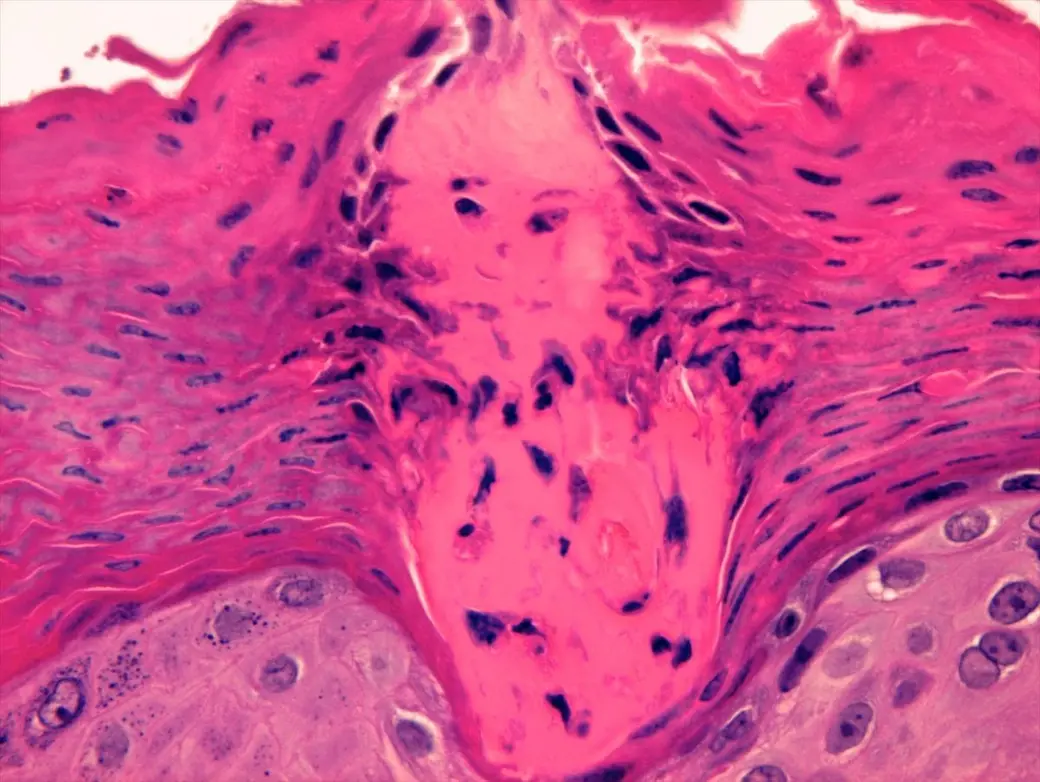
在顯微鏡下,汗孔角化症(Porokeratosis)的切片常常令人著迷。那一條細長的 cornoid lamella(角質柱),像是一道微縮雕塑,靜靜矗立在角質層裡,帶著某種幾乎詩意的秩序感。這樣的影像乍看之下「很可愛」,彷彿是一個隱藏在皮膚宇宙裡的小藝術品。
然而,當它長在病人的皮膚上時,情況就完全不同了。這些環狀、邊界清晰卻持續擴張的病灶,不僅帶來搔癢,更帶來心理層面的困擾。病人往往帶著笑容訴說:「醫師,我很困擾。」但那笑容底下藏著一種無奈的「阿格里」,被某種命運纏繞而無法逃脫。
多樣卻不完美的治療選項
汗孔角化症的治療方式很多,但沒有一個放諸四海皆準的標準答案:
傳統外用藥物:像是 A 酸類(tretinoin)、5-FU、Imiquimod、Vit D 類似物。這些藥物在特定亞型或個案報告裡有效,但整體療效有限。
物理治療:冷凍治療、CO₂ 雷射、光動力療法(PDT),適合局部或頑固病灶。
口服治療:如 Acitretin,用於廣泛或頑固型,但副作用與長期耐受性成為限制。
手術切除:針對孤立且惡變風險高的病灶。
最令人頭痛的是,這些治療方式都不是針對病因,而是治標不治本。
神奇的「外用 Statin/Cholesterol 藥膏」
近幾年的研究帶來一個令人驚訝的新方向:statin/cholesterol 外用組合療法。
原來,汗孔角化症的發病機制與 mevalonate pathway(甲羥戊酸途徑)缺陷 有關。這是一條與膽固醇、細胞膜穩定性有關的重要代謝路徑。當這條路徑出問題,角質細胞的分化就出現異常,形成了我們在切片裡看到的 cornoid lamella。
研究者靈機一動:既然問題出在 mevalonate pathway,為什麼不直接「補回去」?於是他們嘗試將 statin(如 lovastatin 或 simvastatin 1–2%) 與 cholesterol(2%) 配成藥膏,讓患者每日塗抹兩次,持續 8–12 週。結果發現,大部分患者的病灶有顯著改善,甚至完全消退,而且安全性良好。
這是一個徹底「病因導向」的治療思維,不再只是破壞病灶,而是把病理的代謝缺陷補回去。
不過,這種藥膏目前 沒有現成商品,只能透過 醫師處方 + 藥師配製(compounding) 方式取得。這也解釋了為什麼許多臨床醫師,包括您,過去從來沒有聽過這個方法——因為它還沒被製藥公司商品化,而只存在於文獻與專門調劑藥局之間。
長期監測的重要性
即便有了新的療法,汗孔角化症仍是一個需要謹慎看待的疾病。研究指出,它的惡性轉化風險約 7–16%,依不同亞型而異。因此,無論選擇什麼治療,長期監測、定期隨訪 仍是必要的。
在病理切片下,汗孔角化症是可愛的。
在病人的皮膚上,它卻是沉重的。
如今,外用 statin/cholesterol 藥膏 為我們帶來了一絲新的希望。這種聽起來「很神奇」的治療,或許正是從「顯微鏡的藝術品」走向「臨床的實際解方」的橋樑。
Treatment options for porokeratosis are diverse and depend on the clinical subtype, extent of disease, and risk of malignant transformation. The most up-to-date consensus highlights topical statin/cholesterol combination therapy as a promising pathogenesis-directed approach, particularly for disseminated superficial actinic porokeratosis (DSAP) and other subtypes. Clinical studies and meta-analyses report that topical lovastatin or simvastatin combined with cholesterol, applied twice daily for 8–12 weeks, leads to significant improvement or resolution in most patients, with a favorable safety profile.[1][2][3][4][5] This approach targets the underlying mevalonate pathway defect now recognized in porokeratosis pathogenesis.
Other topical agents with variable efficacy include topical retinoids (e.g., tretinoin), imiquimod, 5-fluorouracil, and vitamin D analogs. Topical retinoids are particularly useful for linear porokeratosis and have shown marked improvement in case reports.[6][7] Imiquimod and vitamin D analogs may be considered for DSAP and other forms, though evidence is limited to case series and reports.[6]
Physical modalities such as cryotherapy, laser ablation (including CO₂ laser), and photodynamic therapy are options for localized or refractory lesions, especially when topical therapy is impractical.[6][8][9] Surgical excision may be reserved for isolated lesions with high risk of malignant transformation.
Systemic therapy, most notably oral retinoids (e.g., acitretin), can be considered for extensive or recalcitrant disease, but long-term efficacy and tolerability are variable.[6][10]
No standardized guidelines exist, and treatment should be individualized. Long-term surveillance is recommended due to the risk of malignant transformation, which ranges from 7–16% depending on subtype.[4][5]
References
-
Topical Cholesterol/Lovastatin for the Treatment of Porokeratosis: A Pathogenesis-Directed Therapy. Atzmony L, Lim YH, Hamilton C, et al. Journal of the American Academy of Dermatology. 2020;82(1):123-131. doi:10.1016/j.jaad.2019.08.043.
-
A Review of the Efficacy of Topical Statins for Treating Disseminated Superficial Actinic Porokeratosis. Ghani H, Richards E, Truong TM, Rao BK, Zhang A. Journal of Drugs in Dermatology : JDD. 2023;22(10):1053-1057. doi:10.36849/JDD.7540.
-
Efficacy of Topical Cholesterol and Statin Combination Therapy in the Treatment of Porokeratosis: A Systematic Review and Meta-Analysis. Casale F, Walters N, Peach A, Dong J. Journal of Drugs in Dermatology : JDD. 2023;22(12):1160-1165. doi:10.36849/JDD.7775.
-
Porokeratoses: An Update on Pathogenesis and Treatment. Kostopoulos-Kanitakis KA, Kanitakis J. International Journal of Dermatology. 2025;64(1):62-71. doi:10.1111/ijd.17411.
-
Malignant Transformation in Porokeratosis Ptychotropica: A Systematic Review. Loh CH, Tan CL, Tan KB, Sudhoff H, Goon P. Acta Dermato-Venereologica. 2024;104:adv40558. doi:10.2340/actadv.v104.40558.
-
Treatment of Porokeratosis: A Systematic Review. Weidner T, Illing T, Miguel D, Elsner P. American Journal of Clinical Dermatology. 2017;18(4):435-449. doi:10.1007/s40257-017-0271-3.
-
Generalized Linear Porokeratosis. Dervis E, Demirkesen C. International Journal of Dermatology. 2006;45(9):1077-9. doi:10.1111/j.1365-4632.2004.02490.x.
-
Successful Treatment of Porokeratosis With Ablative Fractional Carbon Dioxide Laser and Vitamin C, E, and Ferulic Acid Serum. Nguyen JK, Mancebo S, Bleicher B, Jagdeo J. Journal of Drugs in Dermatology : JDD. 2019;18(11):174-1176.
-
Porokeratosis Ptychotropica Responding to Photodynamic Therapy: An Alternative Treatment for a Refractory Disease. Fustà-Novell X, Podlipnik S, Combalia A, et al. Photodermatology, Photoimmunology & Photomedicine. 2017;33(5):271-274. doi:10.1111/phpp.12319.
-
Multiple Porokeratomas (Porokeratotic Acanthoma) Coexisting With Disseminated Superficial Porokeratosis: Clinical, Dermoscopic and Pathological Observations, and Review of Published Work. Xu X, Pradhan S, Wang D, Li W. The Journal of Dermatology. 2020;47(7):787-791. doi:10.1111/1346-8138.15376.
本文僅供衛生教育參考,不能取代專業醫師的診斷、治療或處方。實際用藥種類、強度與療程需由醫師依個別病況判斷。若症狀急速惡化、大面積起水泡、合併發燒或傷口化膿,請立即就醫。